Developing New Components
The dwave-hybrid framework enables you to build your own components to incorporate into your workflow.
The key superclass is the Runnable class: all basic components—samplers,
decomposers, composers—and flow-structuring components such as branches inherit
from this class. A Runnable is run for an iteration in which it updates
the State it receives. Typical methods are run or next to execute an
iteration and stop to terminate the Runnable.
The Primitives and Flow Structuring sections describe, respectively, the basic Runnable
classes (building blocks) and flow-structuring ones and their methods. If you are
implementing these methods for your own Runnable class, see comments in
the code.
The Racing Branches graphic below shows the top-down composition (tree structure) of a hybrid loop.
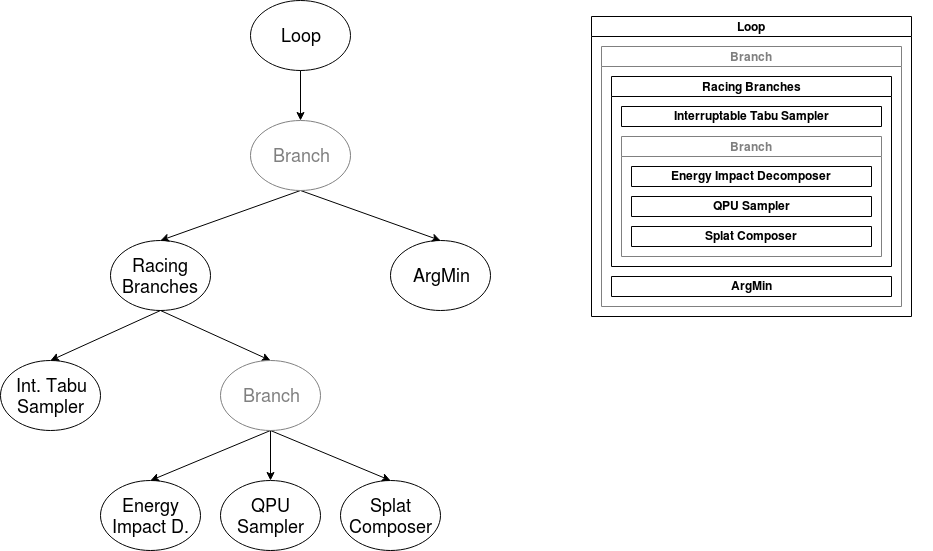
Top-Down Composition
State traits are verified for all Runnable objects that inherit
from StateTraits or its subclasses. Verification includes:
- Minimal checks of workflow construction (composition of
Runnableclasses) - Runtime checks
All built-in Runnable classes declare state traits requirements that are
either independent (for simple ones) or derived from a child workflow. Traits of a new
Runnable must be expressed and modified at construction time by its parent.
When developing new Runnable classes, constructing composite traits can be
nontrivial for some advanced flow-control runnables.
The Dimod Conversion section describes the HybridRunnable
class you can use to produce a Runnable sampler based on
a dimod sampler.
The Utilities section provides a list of useful utility methods.